



 Sales:
 Support:
 Contact Us
 Staff & Client Login

 Get A Quote
Construction Site Security Checklist
There’s a lot to keep on top of when you’re securing a construction site.
Perimeter, plant, cameras, sign-in records and your legal duties all need checking. And each changes as your build moves on.
Ideally, you’d finish each shift knowing every measure’s been checked and every fault has an owner to fix it.
This construction site security checklist should help. To make it easier we’ve combined your checklist by area of your site in the order you’re most likely to walk the site when checking.
We’ve also based it on how we deliver our own construction site security.
What Are The Construction Site Security Requirements?
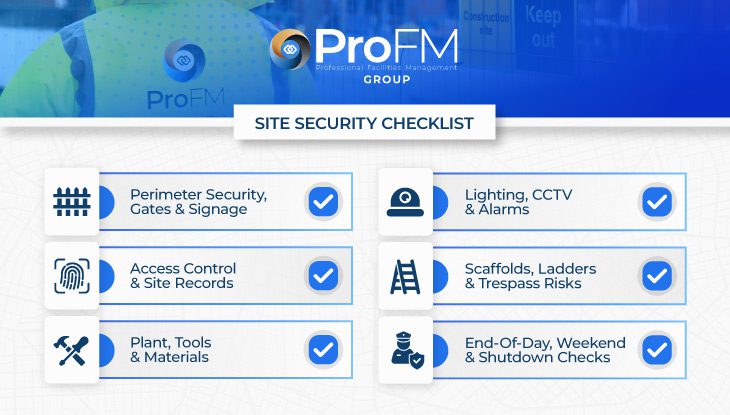
There’s no specific legal checklist that you have to follow, but two responsibilities in the Construction (Design and Management) Regulations 2015 (CDM 2015) set construction site security requirements.
Regulation 13(4)(b) makes the principal contractor take the necessary steps to prevent unauthorised access.
Regulation 18(2) requires the perimeter to be signed or fenced (or both) where health and safety needs it, so far as is reasonable.
The Health and Safety Executive’s L153 guidance explains both, and we’ve covered what CDM 2015 says about site security too.
Perimeter, Gates & Signage
Your perimeter is the first thing to check and is usually where you’ll find a problem first.
We highly recommend you walk the whole perimeter, not just the gate, to get a complete picture:
- The fence or hoarding runs unbroken, with no gaps, damaged panels or lifted sections.
- No materials, skips or spoil are stacked close enough to the line for someone to climb.
- Every gate is locked, and its hinges and locks show no sign of tampering.
- Signs at each entrance identify the site and the principal contractor.
- There are no gaps under the fence where the ground is uneven or has washed out in bad weather.
- Any change to the boundary since your last check has been fenced and signed.
In our experience, the gaps that cause the biggest risk open up along the back fencing that are out of sight the majority of the time, or where the ground dips after heavy rain, so our advice is to walk the full boundary every time.
And because regulation 18(2) ties the duty to the level of risk, the right fence is the one your construction site security risk assessment calls for, not a figure lifted from a generic list.
Access Control & Site Records
Your site is only as controlled as the way in (or ways in) allows them to be. A lax entry point will always create a security risk on the rest of your site. Check these points:
- There’s a single controlled entry point, wherever your layout allows one
- Everyone on site is signed in, including visitors and delivery drivers
- Every new starter has had a site induction before starting work
- Credentials for any contractor no longer working on site have been removed
- Early arrivals and out-of-hours entries are logged with a name and reason
- Someone has reviewed any sign-in log for gaps or unfamiliar names
Regulation 13(4) puts the site induction and prevention of unauthorised access on the principal contractor, so these checks are important for covering yourself.
They also catch what perimeter checks miss, like theft from people who let on site.
For bigger or high-value sites, access control with fobs or cards gives you the most accurate entry and exit records.
Plant, Tools & Materials
Every site has items that are easy to carry away unnoticed (think hand or power tools) and equipment that’s hard to recover or replace at short notice (large machinery) so these need a specific item on your checklist to keep things as safe as you can.
Before the last person leaves your site, check that:
- Keys are out of all vehicles and equipment and that immobilisers or isolators are engaged
- Tools and loose materials are locked in a compound or secure container
- You have an asset list of every item of plant or equipment with serial numbers and photographs
- Cable, copper and other high-value materials are stored well away from your gate
- Trackers are fitted to high value machinery or vehicles
- Fuel tanks and bowsers are locked and fuel levels are recorded at the end of the day
Lighting, CCTV & Alarms
Security technology is a great asset for construction sites, especially large ones that manned guarding can struggle to manage alone. But it’s only going to work if it’s properly installed and checked regularly (because cameras can be moved by intruders to create blind spots you wouldn’t know about without checking)
- No gate or building sits in a “dark zone” at night
- Cameras covering entrances, stores and plant can identify people and vehicles, and lenses are clean
- Mobile units have power (mains or solar) and a live connection
- Alarms are armed and confirmed as communicating with the monitoring centre
- CCTV signage is on display and footage storage matches your data protection policy
- Every false alarm is logged with a cause and followed up
From your site cabin, a camera that’s offline looks exactly like a working one if the feed isn’t being checked. So check the connection first.
Mobile CCTV towers and visually verified alarms (VPOD) send images to a monitoring centre (for us, that’s our National Operations Centre).
Our SIA-licensed operators can then see what triggered the alert before anyone’s sent out to your site.
Scaffolds, Ladders & Trespass Risks
Your site’s structures can give people a way in, including kids looking at a construction site like a playground, so look for these things at the end of each day:
- Ladders are removed or boarded off at the end of every shift
- Scaffold access points are blocked at ground level
- Damaged fencing and trespass reports are investigated the same day
In England and Wales, section 1 of the Occupiers’ Liability Act 1984 means an occupier can owe a duty of care to trespassers where they know a danger exists and that someone could come across it.
End-Of-Day, Weekend & Shutdown Checks
Every Night Check
- Gates are locked and hoarding is sound after the day’s work
- Compounds are locked and keys are in a locked safe
- Immobilisation is confirmed on all machinery
- Security lighting has come on and covers your gates and compound
- Alarms are on and the monitoring centre has confirmed it’s receiving signals
- Your shutdown log is signed and dated by the person who completed it
Weekends & Shutdowns
Longer closures, like Christmas shutdowns, need everything above plus three more points before you walk away:
- Monitored detection covers your site for the full closure.
- Your escalation contacts are named, with phone numbers that will be answered
- You know who attends if your alarm goes off (a keyholder, an alarm response officer or a mobile patrol).
We’d recommend agreeing with your provider who’ll respond to out of hours alarms before.
Dependable Construction Site Security Solutions With ProFM Group
What’s important to understand is that a construction safety checklist is only as good as the last time it was used.
And the checks most likely to fail out of hours are the ones your team can’t always manage alone.
A single security partner that monitors your cameras and alarms and sends someone when they fire knows your site through every phase.
We hold Approved Contractor status under the Security Industry Authority (SIA) Approved Contractor Scheme (ACS) and our officers are vetted to BS7858.
Our CCTV monitoring holds National Security Inspectorate (NSI) Gold, and our NOC monitors the VPOD alarms we supply for construction sites.
Book a site survey call and our team will walk your checklist with you, on your site.
You can get in touch online or call us on 0808 501 5332.
Related Blogs

Emily
Shared Services Director
Emily’s extensive expertise in the field spans over 10 years, and positions her as a thought leader and pioneer for our sector. She discusses key security advice, crucial steps for securing the future, and how our industry is evolving at a breakneck pace.