



 Sales:
 Support:
 Contact Us
 Staff & Client Login

 Get A Quote
How To Write A Construction Site Security Plan
An open construction site costs you more than stolen plant. Trespass and theft can hold up your programme. In the worst case, members of the public can be put in danger. That’s where you need a thorough site security plan that’s able to evolve alongside you.
Investment in construction site security measures is something many principal contractors actively do – we’ve been there to support them in that. But to show you’ve met your legal duties (and give your insurer a clear understanding of your site), you’ll need a well-documented plan in place that turns your security measures from reactive to proactive.
But knowing what to include and, what to take out, is more difficult than you might think.
What Is A Construction Site Security Plan?
A construction site security plan is a documented plan or strategy that outlines the specific risks your site faces, the assigned mitigation measures for that risk, who is responsible for implementing those strategies, and how the plan can evolve as the project does. It’s in place to fully “map out” the process for keeping a construction project safe liability-free throughout its lifecycle.
While you’ll look at the project as a whole, your construction site security plan should be routinely updated as the project progresses. It’s not designed to be a static document – risks evolve and change, and your strategies need to reflect that.
This is a common pitfall, and one that can leave construction sites vulnerable, especially if it’s not been updated following major milestones (like new developmental phases or evolving residential spaces) or since the project’s mobilisation. We’ll address how to keep your plan updated (and the points in the lifecycle where we’d recommend a review) as part of our guide.
The Construction (Design and Management) Regulations 2015 (CDM 2015) don’t give you a standalone document called a construction site security plan, but your security arrangements should be recorded in, or controlled through, your construction phase plan.
Our guide to what CDM 2015 says about site security covers the regulations in detail.
What Are The HSE Requirements For Construction Site Security?
If you’re the principal contractor, CDM 2015 says you need to take necessary steps to stop unauthorised access to your site (Regulation 13(4)(b)).
This is added to by the Health and Safety Executive (HSE).
Where there’s a particular risk, Regulation 18 says you need a perimeter, fencing, or both, that’s easy to see, as long as it’s “reasonable practical” on your site.
What that looks like depends on the specific risk around your site and there’s no definitively right or wrong answer.
In the HSE’s Protecting the Public guidance (HSG151), it says a 2m fence is effective for most sites, but expects more where the risk is higher, like city-centre sites or housing areas where kids have tried to get in to the site before.
What Are The Security Requirements For A Construction Site?
At the least, your site needs an obvious and maintained perimeter, controlled entry and exit points, secure storage for plant, tools and materials, and a clear out-of-hours plan for who responds to an alarm or breach.
Everything after that, from CCTV towers to manned guarding, should be chosen from your risk assessment rather than a standard package.
Who’s Responsible For Writing A Construction Site Security Plan?
On a project with more than one contractor, the principal contractor (likely you if you’re reading this) prepares the construction phase plan and owns the security arrangements in it.
Our guide to security for principal contractors covers the role in more detail.
On a single-contractor job, the contractor does.
A construction security provider can survey your site and draft procedures for you, but outsourcing that work doesn’t transfer your CDM responsibility.
What Should A Construction Site Security Plan Include?
Your plan needs to be specific, with an owner against every action, whether that’s your own team or your security provider. How long it is doesn’t really matter as long as it covers those things.
This is a quick checklist you can use:
- Who owns the plan, who approves it, the version, the current build phase and the next review date
- Site plans and aerial views, marked with your boundary, gates, stores, and camera and detector positions
- Site blueprints, including architectural plans and structural works
- Expected project timeline and the build phases you’ll review the plan against
- A risk assessment summary
- Named security measures and where they’ll be deployed
- Who’s responsible for coordinating security, by role, with a 24-hour contact
- Access control measures and procedures for workers, visitors, deliveries and out-of-hours entry
- Your alarm escalation plan including monitoring centre, primary and reserve keyholders, responder and duty manager
- Who responds to on-site incidents (including trespassing, theft, damage and system failures)
- Emergency evacuation procedures
- Inspection checks for fencing, gates, locks and lighting
- The points for review and revision of the security plan
- Handover requirements for any permanent security systems
We should say here, a template is a good place to start, but it’s only going to count as evidence if it’s completed against your site assessment and is kept current. It shouldn’t just be treated as box ticking exercise.
Keep alarm codes, key safe details and camera blind spots out of any copies, since National Protective Security Authority (NPSA) guidance warns that layout and security-system information can be useful to criminals.
If you’d like a second pair of eyes on your plan, our team can survey your site and recommend measures for each phase. Call our sales team on 0808 168 5246 or get in touch online.
Your Site Security Plan Starts With A Full Site Assessment
Your risk assessment is the foundation of any successful security measures you implement. Without it, you can’t effectively invest in the right measures, or you run the risk of improper protection that increases risk rather than mitigates it.
Risk assessments are also the first step in making a construction site security plan that’s built to your site’s specifications, rather than an off-the-shelf package that doesn’t consider your risk factors. It’s one of the important duties of the principal contractor, and guidance from both the CDM 2015 and the wider HSE emphasise the importance of a purpose-built approach to assessing your site for risks.
You should complete a risk assessment as part of every phase of your project – risks change throughout a build, and the hazards that are present during the early stages (like groundworks, or clearing the site for work to begin) won’t be the same as those that are present when you’re laying foundations, completing structural works, fitting out electricals and plumbing, or preparing the site for a final handover to the client.
With that in mind, we’ve created a construction site security checklist of six aspects you’ll need to consider before the first security measure is deployed, and at every phase along the way.
Site Location
Urban sites (such as city-centre expansion projects) will present different risks when compared with more rural locations (renovation at a healthcare facility or vacant property, for instance).
Properties that are adjacent to major roads or footpaths have an increased risk factor, given that they’re more easily accessible to the general public. There’s also the real risk of vehicle-based attacks, which have become more commonplace among organised crime groups, as well as opportunistic theft by passersby.
Particularly crime-prone areas, or those that have seen a spike in more serious crime (like violent offences or armed robbery), will need a more defined approach, and likely have to have further investment to mitigate criminality.
Scope & Scale Of Your Project
Larger or more sprawling projects (new build housing estates or retail expansions, for example) will have more risk factors to consider as part of their ongoing development. That includes both additional access points, increased footfall of contractors/labourers, more frequent vehicle access, and a more pronounced risk of trespassers.
Machinery, Materials, Assets & Equipment
An obvious consideration for all sites, regardless of size or location. The prominence of tool theft in the UK means that, according to data from Kelliher Insurance Group, an estimated 83% of all tradespeople have experienced tool theft across their career, and that’s showing no signs of slowing.
It’s not confined to smaller tools, either – machinery like loaders, dozers, and excavators paint an attractive target for organised criminals, and their rapid trafficking through the black market makes them near-impossible to retrieve after they’re stolen.
It correlates with research from fleet management firm ABAX, which points towards less than 25% of all stolen equipment ever being recovered.
Our guide to the most common types of theft from construction sites offers much more detail on what gets taken and when. Whatever’s on your site, your assets need to form part of every risk assessment you conduct.
Personnel & Foot Traffic
As part of that, you’ll need to consider how they access the areas of your site they need to go to (an electrician may need to visit different areas than a plasterer or joiner, for instance), what risks that creates, and how you can best govern the access they have at any given time. You should also consider the possibility of internal theft – does your workforce itself represent a risk?
It’s also important to consider any periods where your access controls might be left vulnerable as contractors come and go. That’s particularly important if you have contractors arriving early to site to complete works before more people arrive (laying concrete, for example), or your site is predominantly staffed by different subcontractors or independents.
Vehicle Traffic & Access
A more prominent concern for larger sites, vehicle access points are an inherent risk for any construction site. These present an opportunity for hostile vehicles and require a more thorough approach to security.
Similarly, a new build estate is likely to move rapidly through its stages to the point where homeowners rub shoulders with active construction zones. Here, there’s the real risk of accidental trespassing, which can lead to liabilities, inadvertent damages or project delays.
Perimeters & Boundaries
Your site perimeter should be where you both start and end your site security risk assessment. There are the more obvious aspects – perimeter integrity and soundness, for example, play a central role in how you create your construction site security plan. That’s usually done in the form of Heras fencing, or solid hoarding around urban projects that have a continued risk of illegal squatting or criminal damage.
However, there are also the more under-the-radar issues that can present a concern. Uneven terrain can leave gaps that criminals and trespassers seek to exploit under the cover of darkness, while heavy rains or inclement weather can mean that improperly fitted fencing simply doesn’t function as it should.
Understanding Your Security Options
While there’s no single solution for construction site security (the best packages combine a range of different options), there are “pillar” services that a conscientious and well-informed principal contractor will implement as part of their construction site security plan.
Physical measures set your boundary. That means Heras fencing for most sites, solid hoarding where screening or squatting is a concern, anti-climb measures where people could get up a structure, and lighting to remove cover after dark.
Security technology watches your site when nobody’s there. That covers mobile CCTV towers, visually verified alarms like our VPOD system, AI perimeter detection like ProEyez, access control and GPS tracking for plant.
Manned security gives you a physical response, from static security guards and mobile patrols to gatehouse officers on high-traffic projects and canine handling teams on the highest-risk sites.
The the best option to include as part of your construction site security plan is one that combines both manned and technological measures alongside those must-have physical barriers like Heras fencing.
How To Update Your Construction Site Security Plan At Each Phase
While you must have your security plan in place before you get started, it can’t remain the same throughout the duration of your project. Requirements and risks will change as your site does, and your plan needs to specify what changes at what phase of the project, as well as what you plan to do to address any new hazards or security challenges.
Every phase should also mean a refresh of your risk assessment, and how that might have changed during that segment of the construction works. For instance, if a move towards scaffolding around timber frames for housing means that there’ll be additional vehicle traffic, you’ll need to factor that into the risks that face your site.
Here are the stages that are most common in a construction project, and how we’d plan for each one.
Phase 1 – Groundworks, Site Clearance & Preparation
These are the early stages of your project, where your team are scoping out the grounds, clearing away any debris or rubble, and generally preparing the ground for construction to take place. It’s the stage where there’ll be heavy plant like dozers or excavators on site, which present a major risk of theft and vandalism, as well as potentially costly delays if equipment is damaged.
There’s also the prevalence of accidental intruders, too. If you’re working on what might have previously been abandoned land or along a popular route, there may be people who are unaware of the works you’re undertaking, and you’ll have a duty of care (under the CDM 2015 and the Occupiers’ Liability Act 1984) to make sure they’re not injured or put in harm’s way.
The most important aspect to consider as part of Phase 1 is to set up fencing. For most, this will be Heras fencing, but some projects (those in city centres, for example) may benefit from solid hoarding that screens the project from the general public. It’ll also allow you to maintain compliance and avoid any potentially costly breaches.
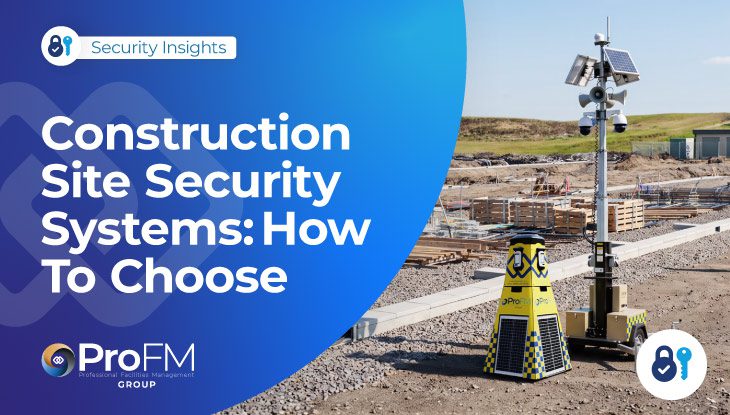
This may also be the time when you start to invest in mobile CCTV towers. Their autonomy and simple setup mean they’re adaptable across multiple phases, and their self-sufficient solar power supply means they need minimal infrastructure.
Finally, if you’re planning to keep any heavy plant or machinery on site during downtime, we’d recommend looking into GPS tracking. It works in the background once it’s set up and it’s worth asking your insurer whether it affects your cover or premiums.
Review your construction site security plan before Phase 2.
Phase 2 – Foundations, Structures & Timberworks
The next phase of a construction project is the introduction of foundational work, followed by structures (like timber or metal frameworks, cladding or sheet metal, or scaffolding) and the start of the project “taking shape”. This can look drastically different, depending on the kinds of work you’re undertaking, but what every project shares is that evolving risk profile.
Adding scaffolding to your structures – while necessary for the majority of construction projects – presents a major risk of trespassing, and paints a target for vandals and antisocial behaviour. Concrete foundations and steelwork can be easily damaged, and loose materials are a target for theft. Above all, though, there’s the risk to your people, who could take the brunt of any damages caused by lax security at this stage of the project.
Scaffolds and ladders need their own controls rather than relying on your fence alone. Remove ladders or fit lockable ladder guards at the end of each shift, and investigate damaged fencing or out-of-hours trespass reports straight away, as HSE advised in a 2018 safety alert summarised in the Lift and Escalator Industry Association’s (LEIA) August 2018 safety update.
We’d recommend reviewing your fencing and perimeter security as a first port of call during Phase 2 of your project. Increased vehicle access, changes to the materials and equipment on site, and even the foundations themselves will all affect how you secure your perimeter. Start by looking at your fences or boarding – does it still effectively surround your site?
Then, consider whether it’s enough. At this stage, construction projects are likely to attract more attention (both positively and negatively), and it may be time to invest in further perimeter security measures. This is the point to add perimeter monitoring (like the ProEyez system), which effectively adds an invisible layer of protection designed to identify threats as they come into contact with your external boundaries.
For this stage, we’d also recommend investing in visually-verified intruder alarms, like ProFM’s VPOD system. This is an affordable yet powerful upgrade, and can work alongside existing tech that you’ve implemented at your site, like the solar-powered CCTV towers we touched on as part of Phase 1.
This is also where larger projects (major business park builds or industrial expansions, for example) will use mobile patrols. These will act as both the first line of defence against any issues detected by the on-site technology, as well as one of the most effective deterrents to criminality and trespassing.
Review your construction site security plan before Phase 3.
Phase 3 – Internals, Electricals, Plumbing & Roofing
The “fitting out” stage of a project is always one of the more stressful for a principal contractor, and from a site security perspective. There’s a long list of things that can (and do) go wrong at this stage, ranging from faulty wiring and rushed sealants around plumbing to the ever-present theft of copper piping and roofing tiles.
High-value materials on site mean that criminals are likely to take notice.
This is one of the most significant phases from a construction site security planning perspective, and can heavily shape the final phases of your project, as well as any handover stages or defect checks.
Here is where your on-site CCTV plays its most important role, and it’s the reason we’ve recommended implementing it as soon as possible in the build process. There are multiple reasons behind its increased importance at this stage:
- It’s a visible deterrent to criminals
- It offers priceless evidence if something does get stolen
- It’s an additional reassurance for independent contractors who leave tools overnight
We’d advise investing further into your CCTV towers if you’ve only got one or two so far, and your project has expanded.
If your project has stayed the same size, you should consider whether work has moved to a different area of the site (refits in a different part of a newly built retail outlet, for example) and if your cameras offer the right view of that area to keep contractors, tools, and equipment protected – your security provider will be able to offer ideal positioning to make sure of full visibility and minimal compliance risk.
We’d also recommend looking into more stringent access control solutions. While early stages of the project may have only required coded locks or locked doors, this phase may necessitate ID badges or (for particularly high-value fit-outs) biometric/facial recognition access. That’s particularly important for sites like new-build supermarkets, where expensive cabling and fridge/freezer components can be a prime target for thieves.
If you’re particularly concerned (you’re completing a build in a high-risk area, for example), there’s little substitute for manned guarding. A static officer positioned at your site who’s able to access your welfare facilities is among the strongest defences against criminal activity, with research showing a significant reduction in the likelihood of criminal activity with the presence of a visible, uniformed security officer.
For severe cases – there have been cases of theft at your construction site, for instance – we’d suggest taking it a step further with canine handling officers. They’re recommended for urgent security requirements and provide one of the most strong deterrents to criminal activity.
Complete a final construction site security plan review before Phase 4.
Phase 4 – Handover & Final Defect Checks
This is often the most overlooked stage of planning for security at a construction site. It’s a common misconception that, once you’ve finished the project and passed keys across to the client, your work is done. It almost is, but from a security perspective, you should still be in control and understand how the building is going to be secured after you leave.
There are a few reasons for that. As the principal contractor, you might be expected (or contractually obliged ) to come back to fix any defects in the construction or workmanship. It may also be that, as is the case with new build estates, you’ll still have some responsibility in the future for the wellbeing of residents and the surrounding area.
These security measures don’t need to be as extensive as the previous three phases. Requirements for access control and CCTV towers will have been reduced, but there will be a need to maintain these, especially if there’s still a risk of unauthorised access while the premises is vacant.
It’s also a good idea at this point to look into more “hands-off” services, like a keyholding and alarm response service. This means you’re still contracting the professionals for a licensed and compliant service, while trimming down any ongoing costs and involvement from you or your team.
Your construction site security plan should also say what passes to the client. Regulation 12 of CDM 2015 covers health and safety, not your temporary site security plan, so hand over permanent security information (built-in alarms, CCTV and access control records, keys and credentials, and maintenance contracts) through your project’s handover.
Take away temporary passes and codes at the same time, putting anything relevant to future construction work in the health and safety file.
When Else Should You Review Your Plan?
There’s no set legal time limit for reviewing a construction site security plan.
Alongside your phase reviews, review it straight away after a trespass, theft, break-in, repeated false alarms, perimeter damage, a change of security provider, or a change to your working hours or site boundaries.
Insurer risk guidance, like Allianz Commercial’s construction site security guidance, takes the same view, recommending a revised assessment whenever boundaries, progress, work sequence or logistics change.
What If I Don’t Have A Construction Site Security Plan?
While it can be tempting to leave things to fate, the costs of not having a plan in place for security are often devastating. It is usually much cheaper to implement proactive security measures, and the headaches and liability issues it prevents are priceless.
The losses come from a combination of thing that hit your bottom line, including:
- Project delays and overruns
- Direct thefts
- Employee thefts
- Replacement equipment costs
- Compensation claims due to lost or stolen tools
Insurance is the other consideration.
Security conditions vary by insurer and policy, so check your Contractors’ All Risk (CAR) wording for minimum security requirements, unattended-site rules and incident reporting times. If your plan can’t show the controls your policy assumes, a claim may be disputed.
There’s also a real chance of injury at your site if security isn’t thorough enough to provide protection under the Occupiers’ Liability Act 1984. The Act gives you a duty towards trespassers where you know about a danger, have reason to believe someone may come near it, and could reasonably be expected to offer some protection against it. On most construction sites that test is easily met, which is part of the reason behind the prevalence of more affordable site security measures (like Heras fencing or temporary CCTV towers).
The consequences of getting it wrong are serious.
In 2022, Howard Civil Engineering was fined £600,000 after a seven-year-old boy died on its site in South Yorkshire. HSE found the fencing around the new-build housing development wasn’t enough to keep unauthorised people out.
The company pleaded guilty to breaching CDM Regulation 13(4)(b) and section 3(1) of the Health and Safety at Work etc. Act 1974.
Beyond fines and costs, failures like this can lead to enforcement notices, civil claims, disputed insurance losses and project delays.
That doesn’t even touch on the reputational damages that it can have. A company that’s found negligent in their site security is one clients will think twice about hiring.
How Do I Choose My Construction Site Security Provider?
You need to choose a provider that delivers value and can actually provide the services your site needs at every phase.. The right security provider is able to adapt easily, offering both their own insights into the right security measures and working alongside you to mitigate risk and protect assets.
These are the things to check:
Accreditations & Certifications
Look for the right certifications to make sure that your provider is registered and licensed to carry out the duties you’re expecting. As a baseline, you’ll need to make sure that your chosen provider’s officers are licensed by the Security Industry Authority (SIA).
SIA licensing is a legal requirement for anyone carrying out licensable security work, like manned guarding. We’d also advise looking for companies that are ACS-approved, which means that they’re part of the SIA’s Approved Contractor Scheme, a voluntary initiative that sees companies audited rigorously.
We’d also recommend looking for an accreditation you might be more familiar with – Constructionline. Done on a sliding scale between Constructionline Approved and Constructionline Gold, this shows a company has passed the prequalification checks many principle contractors ask for.
You should also look for:
- SafeContractor approval
- National Security Inspectorate (NSI) Gold
- ISO45001 – Health and Safety
- ISO9001 – Quality Management
An excellent company will tick all of those boxes, and more besides, giving you confidence that you’ve got a conscientious, accredited security provider.
Vetting & Screening Processes For Officers
All of the officers who secure your site should, at a minimum, be licensed by the Security Industry Authority (SIA). They’ll be able to evidence this at all times with their licence, which is usually kept in a lanyard or shoulder pouch.
We would also advise asking your provider what kind of vetting and screening procedures their security personnel undergo. The gold standard for this is BS7858, which is the official British Standard of “Security screening of individuals employed in a security environment”.
You might also choose to look at additional training that officers undergo, with a major consideration being Action Counter Terrorism (ACT) training, particularly on larger or higher-profile projects. Threat levels change, so check the current UK terrorism threat level rather than relying on one you’ve read before.
Availability & Contactable Hours
Threats to your site’s integrity and safety don’t sleep, and you need cover that’s available on a 24/7 basis. Most security providers will offer this capability – it’s an underpinning factor of the industry itself – but it’s important to recognise how that can differ between different security companies.
For instance, does the provider have an emergency response function? At ProFM Group, we have our National Operations Centre (NOC), which functions on a 24/7/365 basis and is consistently manned by SIA-licensed operatives. They’re able to deploy a licensed officer as soon as an alert is detected at your site, and rapidly mobilise the right actions.
A Consistent, Flexible Solution With ProFM Group
What’s important to understand is that your security plan is only as good as its last review. The measures that suit groundworks won’t suit fit-out, and a provider who can change with you saves you re-tendering at every phase.
That’s where ProFM Group lead the way as a security partner for those in the construction industry.
ProFM Group have a proven track record of supporting the construction sector with adaptive, intelligent security that’s grounded in both the future of our sector and real-world experience. It’s a strategy we’ve delivered across projects nationwide, and that we actively deliver for one of the UK’s largest construction suppliers in SIKA.
Our National Operations Centre (NOC) forms the backbone of the packages we deliver, providing 24/7 support for all the sites we secure, and a knowledgeable presence that’s just a phone call away. It underpins our extensive service catalogue that spans every aspect of site security, from those early building blocks to reliable, intelligent security technology.
We pride ourselves on being at the forefront of security developments, and that’s most clearly reflected in our temporary technology. From the VPOD visually-verified intruder alarm and solar-powered CCTV towers to the ProEyez perimeter detection package, we’ve built a range of technology purpose-built for construction site security.
That’s customised around the different phases of your construction site development, and always in line with the expectations of both the principal contractor and the end client. Our suite of services is built specifically so we can support your project throughout its lifespan, from the first ground break to full client handover.
If you’d like to partner with professionals, get in touch with our expert team to book in your first site survey. From there, we’ll show you where your site is vulnerable and recommend measures for each phase of your build. Call our sales team on 0808 168 5246 or contact us online.
Related Blogs


John
Group Chief Executive Officer
John has a proven track record for motivating and leading high performance teams and has helped mentor and develop many people at ProFM Group who now hold key or senior positions within the business. John is committed to delivering only the finest services, exercising compelling leadership, maintaining good internal morale and striving to resolve any challenges efficiently and effectively.