



 Sales:
 Support:
 Contact Us
 Staff & Client Login

 Get A Quote
Mobile Patrols vs Static Guarding: Which Is Right For Your Construction Site?
Construction site security is non-negotiable. Whether that’s from a compliance perspective, in preventing costly and often devastating delays, or simply from keeping materials and people protected, understanding how to best protect your project is fundamental to keeping your build on track.
What Are Mobile Security Patrols & Where Would I Use Them?
Mobile security patrols (also referred to as mobile patrols, mobile guarding, or mobile response security) involve an SIA-licensed security professional conducting regular patrols of a site or premises. They will usually focus on the perimeter of the site, but can also conduct internal patrols, check for security breaches, and investigate any potential disturbances.
For most sites, these will be completed on foot, but for larger projects (a new-build housing estate, for instance), the officer may be equipped with a vehicle to ensure that the whole of the site can be checked. This will not impact the regularity or thoroughness of the patrols that are conducted, however.
Mobile security is often recommended for larger-scale construction projects. While we’ve touched on housing estates as a prime example, we’ve also deployed mobile patrols to excellent effect across a range of sites, including:
- Energy infrastructure & storage installations
- Retail refits and renovations
- Controlled demolition sites
- Large-scale civil and highways work
- Newly built industrial or manufacturing facilities
- Vacant properties or those earmarked for development
They’re used here as the perimeter of these sites (especially energy industry projects) can often be complex and sprawling, requiring a more responsive approach to ensuring the ongoing integrity of the site’s border. That’s not just essential for security, either – injuries and illegal trespassing at your construction site can be incredibly damaging, as we’ve explored in https://www.profmgroup.com/news-insights/construction-site-trespassing/.
Mobile patrols at construction projects are also one of the more fluid options to implement as your project grows and moves through its phases. While a static presence may need to be relocated (along with any welfare facilities) as your project rotates to a new focus area, mobile patrols won’t need that same consideration.
Equally, if you’re demobilising an area of your site fully (a partially completed housing estate, for instance), mobile patrols can be adapted to include any new areas of the site and remove the now-finished areas from any patrols.
However, there are certain circumstances where mobile patrols won’t work as effectively as a well-positioned stationary presence.
What Is Static Security & Where Would I Use It?
Static security usually refers to a trained, SIA-licensed security professional who is strategically positioned to protect a specific spot on a site. This is usually the entrance or main vehicle thoroughfare, as this is often where the biggest threat to site security is. They’ll usually have a welfare cabin or gatehouse function as part of this.
These officers will usually have additional, more complex duties beyond monitoring the site’s entrance. They’ll be expected (and trained) to deliver site-specific health and safety inductions, admit visitors, direct traffic, accept deliveries and (for specialist projects like major excavations or high-rise buildings) conduct Banksman duties.
Static security is usually recommended for self-contained projects that have a single or closely connected entrance. That could include:
- High-rise housing, often in tightly-compacted city-centre areas
- Remote vacant property renovations
- Renovations or refits on an existing business park
- Projects on a private housing estate
- Large-scale projects where Banksman services are needed on a routine basis
In these scenarios, guards will often be positioned in a gatehouse or cabin with attached welfare facilities to both maintain a consistent presence (even during break periods) and so that visitors are met with a recognisable presence upon arrival. It’s also an ideal way to guarantee that your protection is where you need it, when you need it.
In fact, as part of our work with multiple construction companies nationwide, we’ve deployed static guarding packages that are designed to offer permanent coverage at critical checkpoints points across construction sites, including machinery and heavy plant in situ.
Should I Use Both Static & Mobile Construction Site Security?
Yes, and large-scale projects can often benefit from a blend of the two. A blended approach also acts as a stronger deterrent to opportunistic criminals, and the additional coverage can reduce your insurance premiums over time.
According to the latest regulations, that’s essential. Our guide to the CDM 2015 regulations explores this in great detail, but in a nutshell, there’s a definitive need for site security that’s flexible enough to move alongside your project. Both static and mobile guarding have their place here, and fulfil different functions as part of that.
While static guards will act as your first line of defence and first point of contact for your contractors, mobile patrols can monitor continuously for any perimeter breaches and proactively address issues with your site’s security (such as illegal trespassing or damaged fencing).
The only caveat to that, and where many struggle, is cost. While having both a static and mobile presence on site can cause costs to rise, the crime mitigation it allows for can quickly offset that. However, you might also choose to implement a “roving” officer who conducts regular patrols but is predominantly based at a gatehouse or the entrance to your site.
This saves money and still fulfils both aspects of your construction site security planning, alongside offering that licensed protection your insurers, site personnel, and end client will appreciate.
How Can Technology Help My Construction Site Security?
Technology is quickly becoming a part of manned security solutions for construction sites, and there’s nowhere that’s truer than at the intersection of both static and mobile guarding. A prime example of that is a patrol logging and monitoring system. Historically, that would’ve been done through a pen-and-paper method (like a logbook) – modern tech circumvents the need for that.
Essentially, this is done through strategically positioned RFID tags across your site. To a passerby or onlooker, these will look like QR codes, but as part of a patrol management system (we use SmartTask system for our patrols, a mobile patrol management platform that logs each tagged checkpoint in real time), they’ll act as checkpoint“markers” along a predetermined patrol route.
Take a new build housing estate as a great example of how this might work. Your security provider should work with you to plot out a route that encompasses the most important areas of your project, including:
- Areas of active building/project work
-
- Borders with public access routes (like pathways or roads)
- Material and equipment storage
- Toolsheds (tools are officially the most stolen items from construction sites)
- Heavy plant and machinery
- Site manager’s facilities and offices
These areas are essential in keeping the site safe, functioning, and legally compliant. While they’re only examples, they do represent some of the most common pressure points for the construction industry, and implementing a “tagged” patrol system that monitors those areas on a regular basis alleviates that pressure.
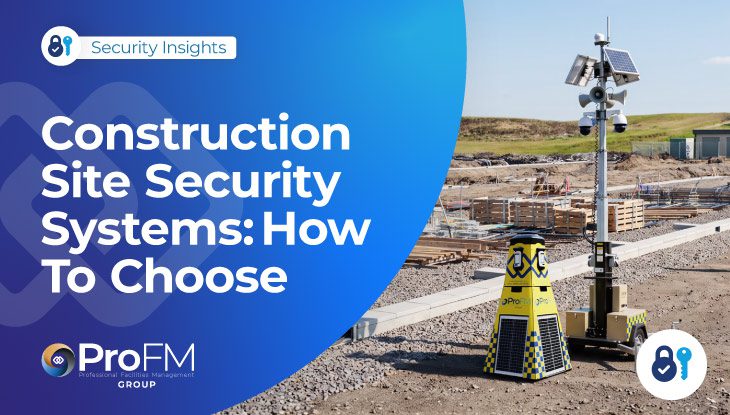
Technology can be used to augment your manned site security solutions, we’d also advise looking into solar-powered CCTV towers. Easily deployable, fully autonomous, and able to run without power or connectivity, these are an additional pair of eyes at harder-to-reach spots on the site and can issue automated alerts to a device that’s stationed with your officers.
They’ll then be able to investigate and, where there is an issue present, escalate it appropriately (either through their training in conflict resolution or to the emergency services where the risk is too great).
Those are far from the only options, however, and by partnering with the right security provider, you’ll be given the full scope of technology that’s built to revolutionise how you view site security.
An All-Encompassing Approach With ProFM Group
A partnership with ProFM Group ensures that every aspect of your site is covered and covered consistently. Whether that’s in a static security professional who’s got extensive training in both Banksman operations and health and safety inductions, or mobile officers equipped with a smart device with full patrol logging, we’ve cultivated a reputation as a one-stop shop for construction site protection.
Our manned security is second to none – it’s earned us the #1 ranking under the Security Industry Authority’s (SIA) Approved Contractor Scheme (ACS) for 6 years running and has seen us be finalists in countless industry awards, including the ACS’ Pacesetters scheme. That’s just the surface – we’re fully Constructionline Gold-accredited, so you know you can trust us with your site’s unique health, safety and compliance challenges.
And while we’ve got demonstrable evidence of how we can deliver those manned options (whether that’s static or mobile construction site security), we’ve not left the technology behind. Our RFID-tagged patrols, coupled with SmartTask’s bespoke mobile application, ensure that our officers can scan those key points on your site time and time again, and that you can track those metrics in real time.
Plus, with NSI Gold accreditations for all of our CCTV packages, you can rest assured of a solution that’s every bit as accredited as it is professional. Give our in-house security experts a call today on 03444 779991 (or send us an email on [email protected]) and we’d be happy to deliver a purpose-built quotation that’s designed around your project’s specifications.
Related Blogs

John
Group Chief Executive Officer
John has a proven track record for motivating and leading high performance teams and has helped mentor and develop many people at ProFM Group who now hold key or senior positions within the business. John is committed to delivering only the finest services, exercising compelling leadership, maintaining good internal morale and striving to resolve any challenges efficiently and effectively.