As professionals in security services, ProFM Group take the security and safety of property and people seriously. Knowing the crime stats for your area can help you protect yourself and your business from crime, as well as help you decide what security services you need to put in place.
To provide the best possible insights into the security measures you can put in place for optimal protection, we’ve collated data to rank the most dangerous areas of London. For this year’s ranking, we’re using the most recent data that’s available from the Metropolitan Police, looking at data from January 2025 to December 2025. By ‘most dangerous’, we mean the areas with the highest crime rate.
However, instead of ranking areas in terms of the total number of crimes committed, we’ve looked at crime rates in proportion to the population for each of the 15 worst boroughs in London, ranking them based on the number of offences committed per 1,000 people.
This not only allows us to take into consideration key factors like population and area density, but it also means we can provide a more objective overview of the most dangerous areas in London.
What Is The Overall Crime Rate In London?
The UK’s capital city, and a hub for British tourism, commerce and culture, London is as synonymous with the River Thames as it is with the fast-paced and often high-octane business world of Canary Wharf and Westminster.
It’s also a melting pot of diversity, from the more tranquil surroundings of the city’s major parks to the hustle and bustle of traditional markets that hark back to London’s illustrious history. There are no words to fully describe London, and with a staggering 30 million visitors each year, it clearly holds appeal for a range of different people.
Of course, that popularity does create its own issues, and that’s most apparent in London’s worrying rate of crime. The city sees around 93 crimes per 1,000 residents, which, while it’s around 2.7% lower than last year’s statistics, is still a concerning crime rate for the country’s capital.
The chief concern for residents and businesses in the city is the soaring rates of theft (295,784 offences) and violent crime (245,525 offences), both of which have seen rises when compared to the statistics we saw in previous years, alongside equally concerning numbers in vehicle crime (87,213 offences) and drug crime (54,698 offences)
Of course, this only tells a partial story, with London’s boroughs all seeing their own unique issues with criminal activity. Let’s break down the 15 most dangerous areas of London, and how their rate stacks up in comparison to the city as a whole.
A Key Note About Crime In The City Of London
You’ll notice that we’ve not included the City of London district in our list, and for good reason. The region is only a permanent home to around 8,600 people, but with over half a million people working in the area, and multiple millions visiting every day, it sees a hugely disproportionate number of criminal offences.
Over the last year, the City of London saw a massive 8,738 criminal offences, meaning a shocking 1,016 crimes per 1,000 residents, or more than 1 crime for every person living in the region. Of course, this is significantly offset by the number of out-of-area commuters, so it’s difficult to fully gauge how bad crime is in this area of the city.
For this reason, we’ve opted not to include it on our list of the most dangerous areas in London, but tourists, commuters and residents alike should still be mindful of the issues that the district faces.
The 15 Most Dangerous London Areas
15. Hounslow
Overall Crime Rate Of 96.3 Crimes Per 1,000 People
With convenient access to Heathrow Airport and the M14, Hounslow is a well-connected area of London, best exemplified by its diverse cross-section of residents and its vibrant, multi-cultural events calendar. That popularity and extensive schedule, however, means Hounslow finds itself among the most dangerous areas in London.
The borough sees an overall crime rate of 96.3 crimes per 1,000 residents, with the key concern for residents being a rising rate of violent crime (8,687 offences) – a common theme across all London boroughs, but notably prevalent in Hounslow. Coupled with similarly worrying figures in both theft (6,408 offences) and vehicle crime (3,020 offences), the pressing need for security in Hounslow is abundantly clear.
Crime in the borough fell by 0.1% compared with 2024’s statistics.
14. Greenwich
Overall Crime Rate Of 97.4 Crimes Per 1,000 people
Greenwich’s picturesque riverside setting makes it one of the most attractive areas in London, overlooking the borough’s eponymous Park and the Royal Observatory. Despite the idyllic features of Greenwich, though, its high overall rate of crime (97.4 crimes per 1,000 residents) means it’s in 14th place on our list of most dangerous London areas.
The key causes for concern are spread across two more prominent problems – violent offences (9,061 incidents) and theft (6,461 incidents), which together make up more than 55% of all the issues in the Greenwich area. Those come alongside rising rates of both drug offences (1,891 incidents – up by 21.1%) and sexual assault (934 incidents – up by 10.4%).
Crime in the borough showed no change compared with 2024’s statistics.
13. Brent
Overall Crime Rate Of 97.6 Crimes Per 1,000 People
Perhaps most recognised as the home of English football in Wembley Stadium, the borough of Brent offers much more besides sporting prowess when we look beneath that glittering surface. While the positives lie in its cultural and commercial contributions to the city, the major negative is Brent’s overarching crime rate of 97.6 crimes per 1,000 residents.
The major concern for the borough’s residents and businesses stems from a rate of drug crime (2,838 offences) that’s risen by a startling 61.3% when compared with 2024. It’s far from Brent’s only pressure point, though – high rates of both violent crime (9,696 offences) and theft (8,773 offences) complete an unappealing view of this slice of London’s sporting scene.
Crime in the borough rose by 0.9% compared with 2024’s statistics.
12. Haringey
Overall Crime Rate Of 102.5 Crimes Per 1,000 People
One of London’s leafiest boroughs, Haringey’s proximity to the Metropolitan Green Belt means it offers sweeping vistas of London’s rural roots, especially from the region’s towering reaches at Alexandra Palace. However, despite the obvious attractions, Haringey’s crime rate of 102.5 crimes per 1,000 residents strikes a sour note for residents and businesses alike.
Theft (8,171 offences) and violent crime (7,686 offences) are the two main contributors towards the crime rate that earns Haringey a spot on our list of the most dangerous areas in London. However, startling figures in drug crime (2,101 offences) and theft from a motor vehicle (1,977 offences) also serve to underscore the pressing need for security in the Haringey area.
Crime in the borough rose by 2.4% compared with 2024’s statistics.
11. Hillingdon
Overall Crime Rate Of 102.7 Crimes Per 1,000 People
Most known as home to Heathrow, one of the world’s largest and busiest airports, Hillingdon is a borough of two halves. It juxtaposes the rurality of Ruislip and Bayhurst Wood against critical infrastructure like RAF Northolt and household names at Stockley Park. But while that blending is no doubt a plus point, its crime rate of 102.7 crimes per 1,000 residents offers a glimpse of the less-than-ideal nature of Hillingdon.
The borough’s high overall crime rate only tells a partial story, however. As the 11th most dangerous area in London, Hillingdon also sees soaring rates of both violent crime (8,758 incidents) and theft (7,766 incidents), as well as a rate of drug offences (1,576 incidents) that’s seen a 59% increase in comparison with last year.
Crime in the borough rose by 6.2% compared with 2024’s statistics.
10. Lambeth
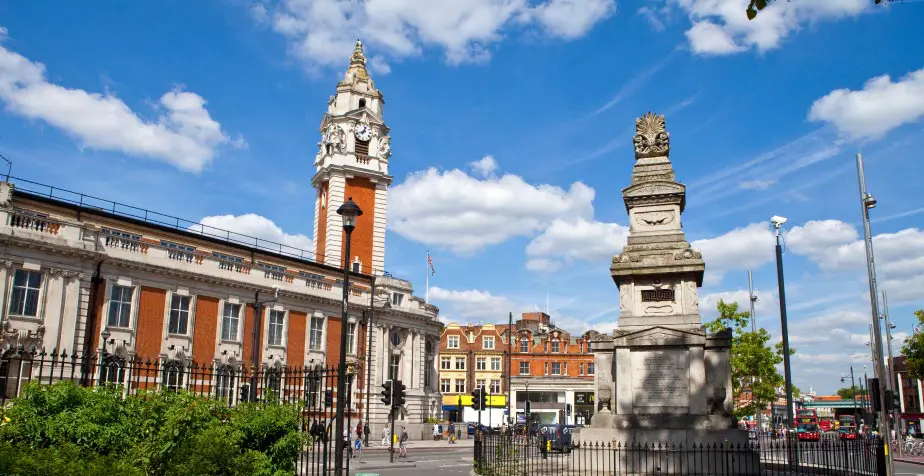
Overall Crime Rate Of 112.3 Crimes Per 1,000 People
Located just across from Westminster and the city centre, Lambeth is an attractive area with strong connections to the beating heart of central London. With an extensive array of additional tourist attractions, including the Imperial War Museum and Florence Nightingale Museum, Lambeth is naturally an attractive spot for tourists and residents alike.
Unfortunately, Lambeth has secured a spot on our most dangerous list because of its significant overall crime rate of 112.3 crimes per 1,000 residents. High instances of theft (13,709 offences) and violent crime (9,454 offences) are Lambeth’s main concerns, with 8 instances of homicide having made headlines in the borough over the course of 2025.
Crime in the borough fell by 2.8% compared with 2024’s statistics.
9. Newham
Overall Crime Rate of 115.1 Crimes per 1,000 People
As one of the host boroughs for the 2012 Olympics, Newham is a prominent destination for sports and culture events, playing host to both the ExCeL centre and West Ham’s London Stadium. It’s this undoubted popularity, however, that means Newham sees itself falling onto the list of the most dangerous areas of London, with a crime rate of 115.1 crimes per 1,000 residents.
Theft (13,859 incidents) is Newham’s biggest issue, with more than 4,700 incidents of shoplifting included as part of that soaring number. There are also equally concerning rates of violent offences (10,431 incidents) and vehicle offences (4,217 incidents).
Crime in the borough fell by 0.5% compared with 2024’s statistics.
8. Hammersmith & Fulham
Overall Crime Rate of 115.8 crimes per 1,000 People
Renowned for its historic terraces and high-achieving schools, Hammersmith and Fulham has since built an equally impressive reputation for its sports scene, being the only London borough to have 3 professional football teams within its borders. That sporting prowess is undercut, however, by the borough’s shocking crime rate of 115.8 crimes per 1,000 residents.
Hammersmith & Fulham’s main issues lie in alarming rates of both theft (6,401 offences) and violent crime (6,034 offences), with vehicle crimes (1,808 offences) being an additional point of concern. Plus, with the football crowds often drawing in the wrong sorts of people, violence both without (3,109 offences) and with injury (1,553 offences) is all too commonplace.
Crime in the borough fell by 2.2% compared with 2024’s statistics.
7. Tower Hamlets
Overall Crime Rate of 116.1 Crimes per 1,000 people
Covering much of London’s traditional East End, Tower Hamlets is known for its rich diversity, international cuisine, and melding of cultures. However, as one of the most deprived areas of the capital, it experiences a crime rate that is all too often associated with poverty – 116.1 crimes per 1,000 residents.
While overarching crime statistics for the borough have dipped slightly in comparison with previous year’s figures, theft (11,055 offences), violent crime (10,421 offences) and drug crime (2,715 offences – up by a notable 12%) all saw substantial – and concerning – figures in 2025.
Crime in the borough fell by 0.2% compared with 2024’s statistics.
6. Hackney
Overall Crime Rate of 116.4 crimes per 1,000 People
An East London melting pot of culture, commerce and independent businesses, Hackney lends its name to the iconic London black cabs, as well as the marshes and greenery that characterise one of London’s most well-recognised boroughs. Despite that sparkling reputation, however, Hackney makes it onto our list of the most dangerous areas in London with a crime rate of 116.4 crimes per 1,000 residents.
Perhaps the most concerning statistics are Hackney’s high rates of theft (11,406 incidents) and violent crime (8,002 incidents), which together paint a negative picture of a borough that’s always been so popular. Plus, there’s been a startling trend of bicycle theft (1,255 incidents), which is unprecedented across most London boroughs.
Crime in the borough fell by 3.3% compared with 2024’s statistics.
5. Southwark
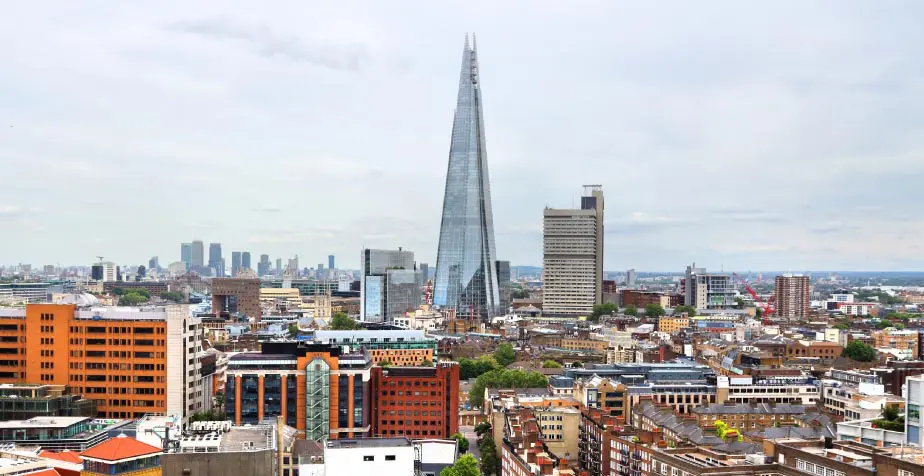
Overall Crime Rate of 123.6 Crimes per 1,000 People
Mostly known for being the home of the literary iconic Globe Theatre, contrasting with the sleek modern architecture of the Shard, you’d be forgiven for not expecting Southwark to be one of the most dangerous boroughs of London. However, with an overall crime rate of 123.6 crimes per 1,000 residents, Southwark finds itself in the top 5 of our list.
Theft (15,987 incidents) is, perhaps unsurprisingly, the most pressing concern for residents, making up approximately 40% of all crime across the borough. Violent crime (9,004 incidents) is the next most prevalent, with burglary (2,556 incidents – up by 6.8%) and drug crime (2,792 incidents – up by 28.9%) presenting equally concerning upward trends.
Crime in the borough fell by 7.1% compared with 2024’s statistics.
4. Islington
Overall Crime Rate of 130.3 Crimes per 1,000 People
Perhaps a surprise entry, Islington – the second smallest borough in London – is better known as a hub of progressive ideas and bohemian subcultures. This is due, in part, to Islington being home to two universities: London Metropolitan University and the University of London. Nevertheless, the borough experiences a soaring rate of crime, at 130.3 crimes per 1,000 residents.
Islington’s main issues lie in worryingly high rates of theft (11,728 offences) and violent crime (7,059 offences), with the latter seeing a rise of 5.5% over last year’s statistics. Plus, despite Islington’s relatively small size, it still sees its fair share of crimes we’d normally associate with larger boroughs, such as public order crimes (2,123 offences) and drug crime (2,035 offences)
Crime in the borough rose by 1.7% compared with 2024’s statistics.
3. Kensington & Chelsea
Overall Crime Rate of 143.3 Crimes per 1,000 People
The Royal Borough of Kensington and Chelsea is most associated with the affluence and wealth of the city’s elite, so it may come as a surprise to see the home of Hyde Park and the Flower Show in 2nd on our rankings of the most dangerous areas of London. However, a year-on-year increase has seen Kensington & Chelsea’s crime rate reach 143.3 crimes per 1,000 residents.
As such a prosperous borough, it’s perhaps disheartening to learn the region’s biggest problem lies in its high rate of theft (8,942 offences), with shoplifting (3,382 offences) and theft from the person (2,224 offences) making up a substantial portion of that rate. There are also equally warranted worries around the rates of violent crime (4,647 offences) and vehicle crime (2,566 offences).
Crime in the borough fell by 2.4% compared with 2024’s statistics.
2. Camden
Overall Crime Rate of 165.2 Crimes per 1,000 People
Camden is a centre of cutting-edge fashion, live music, and thriving alternative cultures. Tourists flock to Camden to visit the British Museum, London Zoo, and of course, the famed Camden Market. Despite its tourist popularity, the area makes 2nd place on the list of the most dangerous areas in London, with an overall crime rate of 165.2 crimes per 1,000 residents.
By a staggering margin, theft (20,020 incidents) is Camden’s main problem, making up a whopping 48.9% of the borough’s total crime figures. The figures in both violent crime (7,372 incidents) and vehicle offences (2,611 incidents) are equally concerning for residents and businesses in the area, in spite of the 5% reduction in overall crime figures.
Crime in the borough fell by 5% compared with 2024’s statistics.
1. Westminster

Overall Crime Rate of 320.8 Crimes per 1,000 People
Home to much of the lively West End, the Houses of Parliament, and Buckingham Palace, Westminster is a bustling hub of activity throughout the year. From the regal to the legal, it’s why many turn to London as a key tourist attraction, and for city breaks and getaways alike. However, the borough’s crime rate strikes a sour note, ranking number 1 in our list of the most dangerous areas of London.
With an appalling crime rate of 320.8 crimes per 1,000 residents – north of 1 crime per 3 people – it’s easy to recognise the concerns for Westminster. Theft (51,104 incidents) is by far and away the biggest issue in the borough, but there are also soaring numbers in violent crime (11,252 offences), vehicle crime (3,825 offences), and robbery (3,432 incidents).
Crime in the borough fell by 9% compared with 2024’s statistics.
Has The Cost-of-Living Crisis Impacted London Crime Rates?
As we continue to go through fluctuating economic conditions, data is starting to emerge about how this is impacting UK crime rates. While it’s difficult to say for certain whether the cost-of-living crisis has had a direct impact on crime in London, it does closely correlate with crime rate rises across 18 of the 32 London boroughs.
Let’s take a more in-depth look at that. In 2024 alone, statistics found that more than 4,500 people were caught stealing from their employers. This is not only indicative of the difficult times we’re living through but also of the opportunistic nature of thieves, with insurer Zurich placing the average cost of business theft at around £36,000.
Of course, while theft from workplaces and offices is a concrete sign that many are turning to criminal activity in the wake of a cost-of-living crisis, there are other figures that could equally point towards money woes.
Here are a few standout statistics on select crimes in London, and their increases over the previous year’s statistics:
- Shoplifting (90,395 offences) rose by 4% when compared to last year’s figures.
- Drug crime (54,698 offences), while not directly related to theft or the cost-of-living crisis, saw an unprecedented rise of 32% over last year’s statistics.
- Robbery from businesses (8,481 offences) rose by 6% in comparison to the previous year.
- Weapon possession (6,584 offences) increased by 7% over last year.
Ultimately, as budgets tighten and we all start to feel the squeeze of rising interest rates and the soaring costs of everyday essentials, these numbers are only likely to increase.
The Pointed Truth About Knife Crime In London
It’s well-documented that knife crime has often been an issue in the capital, and indeed across the UK. Of the 50,430 offences involving a knife or other sharp instrument, 29.5% (14,860 offences) of these happened in and around London. These are just the recorded instances – the actual figures could be much higher.
Looking more closely at the recorded data, more than half (9,008 offences) of all knife crime incidents were part of an armed robbery or burglary. On top of that, there were 4,194 violent assaults involving knives, 1,244 threats to kill that involved knives, and 260 instances of rape and sexual assault that involved a knife.
Of the 499 instances of homicide (murder) that happened over the last year, 95 (or just under 20%) of these were in the London city area. That’s a marked increase over the previous year’s figures, but we’ve yet to reach the numbers we saw pre-pandemic.
This reduction is due in large part to the efforts of charities like The Ben Kinsella Trust, as well as continued investment in private security in London. While they’re predominantly focused on youth knife crime, their work is changing perceptions and providing education and effective preventative measures.
There’s still a long way to go, of course, as the statistics we’ve highlighted here do too good a job of illustrating. But with continued and concerted efforts, this can change and change quickly. Education is the first part of that, and articles like ours, alongside the ongoing work of charities and initiatives, provide the insight we need to take the right path.
Are You A London Resident? Key Safety Tips For Locals
Although we’ve taken the time to highlight some of London’s most dangerous areas, it’s equally true that much of the crime in London is opportunistic. That’s often the case nationwide, too, and we’ve seen time and again that people and premises are at risk when not protected by professional security services.
Criminals often use mopeds or e-bikes to snatch phones from distracted pedestrians, at busy crossings, or outside congregation hotspots like Tube and DLR stations. Shoplifting is so often perpetrated by those who see an opportunity to take something they shouldn’t, or they’ve been pressured into doing so through a range of different factors. And a rising national rate of drug crime only exacerbates that.
The most effective defence in the first instance is to reduce your visibility as a target. We’ve compiled a handful of key tips designed to increase your own awareness and arm you with knowledge in the continued fight against criminality.
1. Reinforce Residential Security
It’s important to start by getting the basics right – all effective security is built on firm foundations and doing these easy things every time.
- Ensure all windows and doors are locked when you leave, even on higher floors. London’s unique architecture can mean that here’s a readymade climbing frame for criminals to access those high-up floors.
- Use Secured by Design, police-approved locks. These are usually more expensive, but they balance out by lowering home insurance premiums and offering increased protection for your valuables.
- Invest in those less-considered options for keeping your home secure. We’d advise looking into anti-snap locks, as many London burglaries involve lock snapping, as well as specialist glass coatings designed to offer a protective “film”.
- Triple check that your lock cylinders are TS007 3-star rated or have an SS312 Diamond rating, as these are designed to stay locked even if the outer housing is snapped off.
Another deterrent is AI-powered CCTV systems, with built-in alarm modules and motion detectors. These modern systems can distinguish between a person and anything that is not, such as an animal, whilst providing real-time alerts and the ability to trigger alarms as a deterrent.
2. Stay Aware On The Streets
While it’s tempting to be in your own world while walking along, it’s vital that you take the time to take stock of the “Look Up, Look Out” rule. This essentially means avoiding walking down the street while looking down at your phone or wearing noise-cancelling headphones. These can significantly reduce your awareness (even in-ear headphones have this capability) and paint you as a more readily-available target for criminals.
We’d also recommend that you have an awareness of your surroundings and avoid isolated areas, sticking to well-lit routes and busy streets, especially at night. This is relatively simple in London for the most part, especially with 24/7 manning at most major Tube stations. However, where it does become more important is in residential areas or closer to home.
For those, reduce your screentime to a minimum, and remove your headphones (or turn off your music or podcast). It’s also a good idea to make a phone call at that time, if you can, as this is a proven deterrent to criminals – if you can’t (due to the time of day, for instance),
If you must use your smartphone, try to stand with your back against a wall so you cannot be approached from behind, and register your device on Immobilise to help police identify and return it if stolen.
This is a more obvious one, as the publicised crime rates on high-value item theft are widely reported, but keep expensive items such as watches covered by sleeves and carry bags across your body rather than over one shoulder.
Business Security Recommendations
As above, make sure your business invests in up-to-date modern CCTV systems, with real-time monitoring and alerts facilitated by a certified operations centre. To enhance this, mobile security response is also highly recommended, ensuring any incidents are responded to in the first instance.
Provide a visual deterrent by hiring professional SIA-licenced security guards to patrol your premises, and for larger grounds, pair these security measures with NASDU-accredited canine patrols.



 Sales:
0808 196 2872
Sales:
0808 196 2872
 Support:
0344 477 9991
Support:
0344 477 9991
 Contact Us
 Staff & Client Login